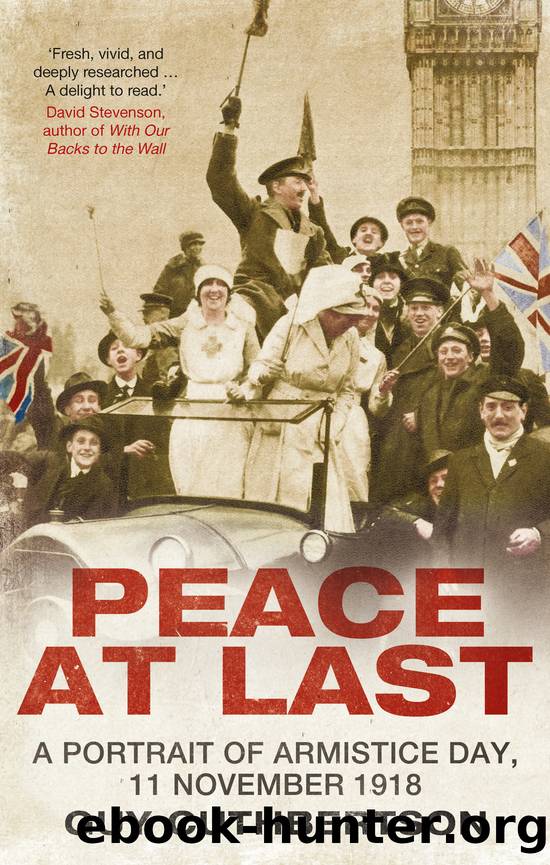
Peace at Last by Guy Cuthbertson
Author:Guy Cuthbertson [Cuthbertson, Guy]
Language: eng
Format: epub
Tags: History, Military, World War I, World, Modern, 20th Century, Social History
ISBN: 9780300233384
Google: n5NyDwAAQBAJ
Publisher: YaleUP
Published: 2018-01-01T20:33:08+00:00
5
ARMISTICE NIGHT
Armistice Night! That night would be remembered down unnumbered generations. Whilst one lived that had seen it the question would be asked: What did you do on Armistice Night?
Ford Madox Ford, A Man Could Stand Upâ, 19261
SUNSET IN LONDON and Paris came at a quarter past four, and in Brussels at four oâclock, as the waxing moon was reaching its first quarter, creating a perfect half-moon.2 Under the same moon, in different towns and cities, the atmosphere continued to build as the light waned, as crowds became larger and more excited, and thus, as twilight became night about two hours after sunset, the magical âArmistice Nightâ arrived. In Oxford, the terms of armistice were read out at Carfax, the crossroads at the city centre, at 6 p.m., as the last light was going, as if to announce the start of Armistice Night. It would be a rainy night to the south of Britain, where Londoners danced in the drizzle, a spell of fine rain âthinned the streetsâ in Banbury for a while in the late afternoon,3 and rain collected in Laurie Leeâs shoes as he watched the celebrations in Gloucestershire. In Gloucester, Ivor Gurney wrote in âThe Day of Victoryâ of how âNight came, starless, to blur all things over / That strange assort of Lifeâ, and
Rain fell, miserably, miserably, and still
The strange crowd clamoured till late, eddied, clamoured,
Mixed, mused, drifted.4
The spirit of his poem is one of gladness and endurance âborn-of-agonyâ, the ability to dance in the rain, yes, but also to be âstrong-mooded above the dayâs inclemencyâ â originally the line was âstrong-mooded above the Timeâs inclemencyâ, emphasising that the rain represented war and mourning.5 The rain becomes a metaphor â âThe dull skies wept stillâ.6 âThe skies were weepingâ in Southampton, while the crowds were singing and cheering.7 But it would be a pleasant night to the north of Britain. In Glasgow it was âpicturesqueâ: âAfter the passing of daylight came frost and along with it a filmy haze, not, however, sufficient to obscure the young moon, whose appearance lent a picturesque note to the scene.â8 In parts of Scotland further north, the northern lights, the aurora borealis, could be seen that evening.9 On the Isle of Man, it was a âbeautiful, calm moonlight nightâ,10 and as the Isle of Man Weekly Times commented, âone may now look up into the starry sky, or out over the silver sea, without feeling that Nature is mocking the sufferings of manâ.11
Nature and man shone and sparkled together, the lights in the sky mirroring the lights that were waking up in the streets below. On that Armistice evening, for the first time in a long while, lights came on in the streets across Britain, flashing out happily, some of the unshaded lights coming on as early as 4 p.m. The use of street lights had been banned during the war, so Wilfred Owenâs âDisabledâ contrasts an unlit wartime twilight with a pre-war time where âTown used to swing so gay / When glow-lamps budded in the light blue treesâ.
Download
This site does not store any files on its server. We only index and link to content provided by other sites. Please contact the content providers to delete copyright contents if any and email us, we'll remove relevant links or contents immediately.
| Arms Control | Diplomacy |
| Security | Trades & Tariffs |
| Treaties | African |
| Asian | Australian & Oceanian |
| Canadian | Caribbean & Latin American |
| European | Middle Eastern |
| Russian & Former Soviet Union |
The Secret History by Donna Tartt(19085)
The Social Justice Warrior Handbook by Lisa De Pasquale(12190)
Thirteen Reasons Why by Jay Asher(8909)
This Is How You Lose Her by Junot Diaz(6885)
Weapons of Math Destruction by Cathy O'Neil(6279)
Zero to One by Peter Thiel(5801)
Beartown by Fredrik Backman(5751)
The Myth of the Strong Leader by Archie Brown(5507)
The Fire Next Time by James Baldwin(5442)
How Democracies Die by Steven Levitsky & Daniel Ziblatt(5218)
Promise Me, Dad by Joe Biden(5153)
Stone's Rules by Roger Stone(5087)
A Higher Loyalty: Truth, Lies, and Leadership by James Comey(4960)
100 Deadly Skills by Clint Emerson(4924)
Rise and Kill First by Ronen Bergman(4788)
Secrecy World by Jake Bernstein(4752)
The David Icke Guide to the Global Conspiracy (and how to end it) by David Icke(4717)
The Farm by Tom Rob Smith(4507)
The Doomsday Machine by Daniel Ellsberg(4490)
